
A Walk Through KC’s Art History by way of KCAI’s Faculty
When it comes to the arts, Kansas City has a storied history. Nicknamed the Paris of the Plains for its fountains and boulevards, KC’s visual arts tradition lives up to the billing as one of the great arts capitals of the Midwest. The Nelson-Atkins houses a world-class collection with an astounding breadth of works, Hallmark boasts a tradition of employing thousands of talented artists, the origins of Walt Disney’s animation empire are a modest studio on 31st, countless galleries offer glimpses at artistic ingenuity of all kinds, and a thriving contemporary community adds beauty and fascination to the city’s activities.
Among the most influential and rich histories in Kansas City’s arts tradition is the Kansas City Art Institute. Its roots reach back to the 1880s as an unassuming club of earnest artists, and in the ensuing decades, it has served as a breeding ground for inspiration. Though it’s impossible to give a comprehensive overview of Kansas City’s historical artists in a blog post, we could get a glimpse of many key members of our local history by way of the Art Institute’s notable faculty of the past. Here are some of the highlights, divided into three eras:
PART ONE: The Early Years
The earliest foundations of the Kansas City Art Institute reach back to an 1885 sketch club. From there, the group grew and found momentum and purpose, beginning classes later that decade. In 1893, they moved to expand, but tragically, a fire at the new location stalled the school for more than a decade. In the first decade of the 20th century, the group found its second wind as the Fine Arts Institute, finally finding a foothold. The 1920s held even greater things: under the leadership of JC Nichols, the school moved to its current campus and changed its name to the Kansas City Art Institute. But with the Great Depression, things came crashing down again.
George Van Millett (1864-1953)
Among the most notable of Kansas City’s artists of the 19th century, Van Millett was a founder of the Paint Club, whose merger with other such organizations marked the earliest forms of the Art Institute, where he taught plein air painting. Van Millett was a prolific portrait painter whose sitters include some of Kansas City’s most influential civic leaders. He served for many years as art curator for William Rockhill Nelson, co-founder of the Kansas City Star and eponymous benefactor of the city’s most notable gallery. In addition to his portraiture, Van Millett was noted for painting gorgeous local landscapes– his trees are especially elegant.
James L. FitzGibbon (1864-1929)
A member of the Kansas City Sketch Club, James L. FitzGibbon is considered among the founders and original four faculty members of what would become the Art Institute. FitzGibbon, foremost known as a watercolor painter, was part of an Irish immigrant family who found his way to Kansas City by way of St. Louis. Though he was certainly known and regarded in his day, much of his work was only circulated decades after his death, when an extensive collection of hundreds of his pieces were disseminated from the estate of his younger sister Mary. FitzGibbon’s scope of work largely consists of deft portraiture and idyllic landscapes.
John Douglas Patrick (1863-1937)
Patrick was a native of Pennsylvania who studied in St. Louis and Paris before accepting a position at the Fine Arts Institute of Kansas City (later called the Kansas City Art Institute) in 1904, where he would remain until a month before his death. He joined the Institute at a pivotal moment in the school’s history: early momentum for the Institute had been abruptly ended by a devastating 1893 fire, crippling the school for more than ten years. Patrick helped lift the Institute from its ashes as its talented principle painting instructor. His work includes figures of considerable character, as well as rural genre scenes and landscapes. You can see his unflinching masterpiece, a large-scale condemnation of animal cruelty titled Brutality (1888), on view at the Nelson-Atkins Museum of Art.
Charles Wilimovsky (1885-1974)
Charles Wilimovsky taught painting and drawing at the Institute in the era of the Great War, from 1914 to 1922. Before that time, he had already moved across the Midwest, studied in Europe, and spent time as a pupil to the great American painter William Merritt Chase, who had a profound influence on Wilimovsky’s own work. His catalogue spans Realism and Impressionism, with subjects ranging from Taos adobes to Midwestern scenes with sweeping skies. Notably, during his tenure in Kansas City, Wilimovsky was one of Walt Disney’s first drawing teachers. After his time with the Kansas City Art Institute came to a close, he spent much of his career teaching at the Art Institute of Chicago, before moving to California in his later years.
Monte Crews (1888-1946)
Missouri native Monte Crews studied with the Art Students League in New York before returning to his home state to teach illustration at the Kansas City Art Institute in 1927. Though his time at KCAI was somewhat brief at six years, he taught notable students including John Falter and Robert George Harris. During his time in Kansas City, Crews also created lively illustrations including magazine covers for Boys’ Life and The Saturday Evening Post. Today, these illustrations often sell for well into the thousands of dollars.
Ilah Marian Kibbey (1888-1958)
Ilah Kibbey was a wonderful painter and printmaker who served as registrar for KCAI circa 1930. During this period, she created genre scenes as part of the New Deal. Kibbey is best known for her oils and watercolors of New England harbors and fishing villages, but also created a small number of aerial landscapes which stood out in this early period of human flight. Though her work is now somewhat scarce to market, she stands as one of the important women in the early days of the Kansas City Art Institute.
PART TWO: Benton & the Mid-Century
In the wake of the Depression, the Institute struggled once more, but a few years on things changed dramatically with a recovered economy and the arrival of the famous Thomas Hart Benton. The school enjoyed the spotlight until another lull in 1941, with Benton’s exit and the coming of World War II. After the war, new faculty would get things back on track quickly, with a helping hand from the GI Bill.
Ross Braught (1898-1983)
First arriving in 1931, Ross Braught joined KCAI at a difficult time in the school’s history: in the midst of the Great Depression, the budget was slim and needed the boost of extensive fundraising. In fact, it was the strain of the Depression that drove Braught, a working artist, to accept the position of head of the painting department in the first place. Under Braught’s direction, the Institute began teaching lithography, its first organized foray into printmaking. His own work reflects a sense of Modernism grounded in the natural world, with abstracted figures blending with idiosyncratic trees set in fantastic landscapes. Though his work spanned a variety of media, he was best-known as a printmaker. Braught left the Institute in 1936, traveling the world and teaching elsewhere, but returned to KCAI for an even longer stint from 1947-1962, before a working retirement decidedly off the grid.
Thomas Hart Benton (1889-1975)
Here finally is the most famous of KCAI figures (or figures in Kansas City’s art history for that matter): Thomas Hart Benton. By the time Benton had arrived as chair of the painting department at the Art Institute in 1935, he was already perhaps the most famous artist in America. He had previously just finished a decade teaching at the Art Students League in New York, where he had mentored future star Jackson Pollock, but was alienated by a New York scene that had little respect for or interest in Benton’s trademark style and brashly independent personality. Benton brought KCAI into the spotlight, and with the economy finally fully recovered, this period was a golden age for the school. It was a golden age for Benton as well, as he created masterpieces including Persephone and Hollywood, and he completed over 100 lithographs to be distributed by the newly formed Associated American Artists. But his tenure at the Art Institute famously came to an abrupt end in 1941, after he mocked the art world for being overrun with effeminate men and homosexuals. The decision to fire Benton was decidedly unpopular in some circles at the time, but history certainly sides with the Institute, however difficult the choice was. Nevertheless, Benton has remained the face of Kansas City art, and his work commands prices as high as ever.
John Stockton de Martelly (1903-1979)
Among Benton’s entourage at the Kansas City Art Institute was friend and fellow Regionalist John de Martelly. If you look at de Martelly’s work at a glance, you’d be forgiven for mistaking the best of his folksy rural scenes for a long-lost Benton. De Martelly helped to expand the school’s printmaking program, which would now incorporate intaglio and relief printing alongside the lithography courses that Ross Braught had established. When KCAI sacked Benton in 1941, the loyal de Martelly would hotly quit as well. Behind him he would leave a legacy of great young printmakers that included Janet Turner, Jackson Lee Nesbitt, and William Wind McKim.
Frederick Kann (1886-1965)
Despite the strong Regionalist presence at the school in the late 1930s, there were other voices present in that era’s faculty. Frederick Kann arrived at KCAI the recent co-founder of the American Abstract Artists, a New York group formed to garner attention for an abstract movement that they felt was marginalized in a scene critically dominated by Social Realism and Regionalism. He was a Czech-American artist with Modernist work crossing from Cubism to Surrealism to pure nonrepresentational abstraction, who exhibited with a lineup of Modernism’s heavy hitters, including Mondrian, Kandinsky, and Calder. Though his time instructing at the Institute was brief, it was an important philosophical foil to the prevalent aesthetic among faculty.
Frederic James (1915-1985)
Among the more ubiquitous (at least locally) but no less distinguished artists on the list, Frederic James was a talented and prolific watercolorist. Though he initially trained as an architect (and was friends with mid-century royalty in Eero Saarinen and Charles and Ray Eames), painting was his passion. A former student of Thomas Hart Benton, James was hired by the Art Institute to teach watercolors in 1940, where he would spend a good deal of the decade, though he did enlist and miss time at KCAI due to WWII. His work lies on the realistic side of Regionalism, luminously capturing the pastoral scenery of rural Kansas and Missouri.
William Wind McKim (1916-1995)
World War II had ended the momentum of printmaking at the Art Institute, an unfortunate hiatus for a tradition built under Braught and de Martelly. But after the war, the GI Bill gave enrollment a major boost, and one of de Martelly’s former pupils, William Wind McKim, was hired to restart the lithography department and teach drawing. He’d remain at the Institute for decades until his retirement. Like so many who had trained at KCAI during the 1930s and 40s, McKim’s work showed a Regionalist influence, but his primary subjects were animals.
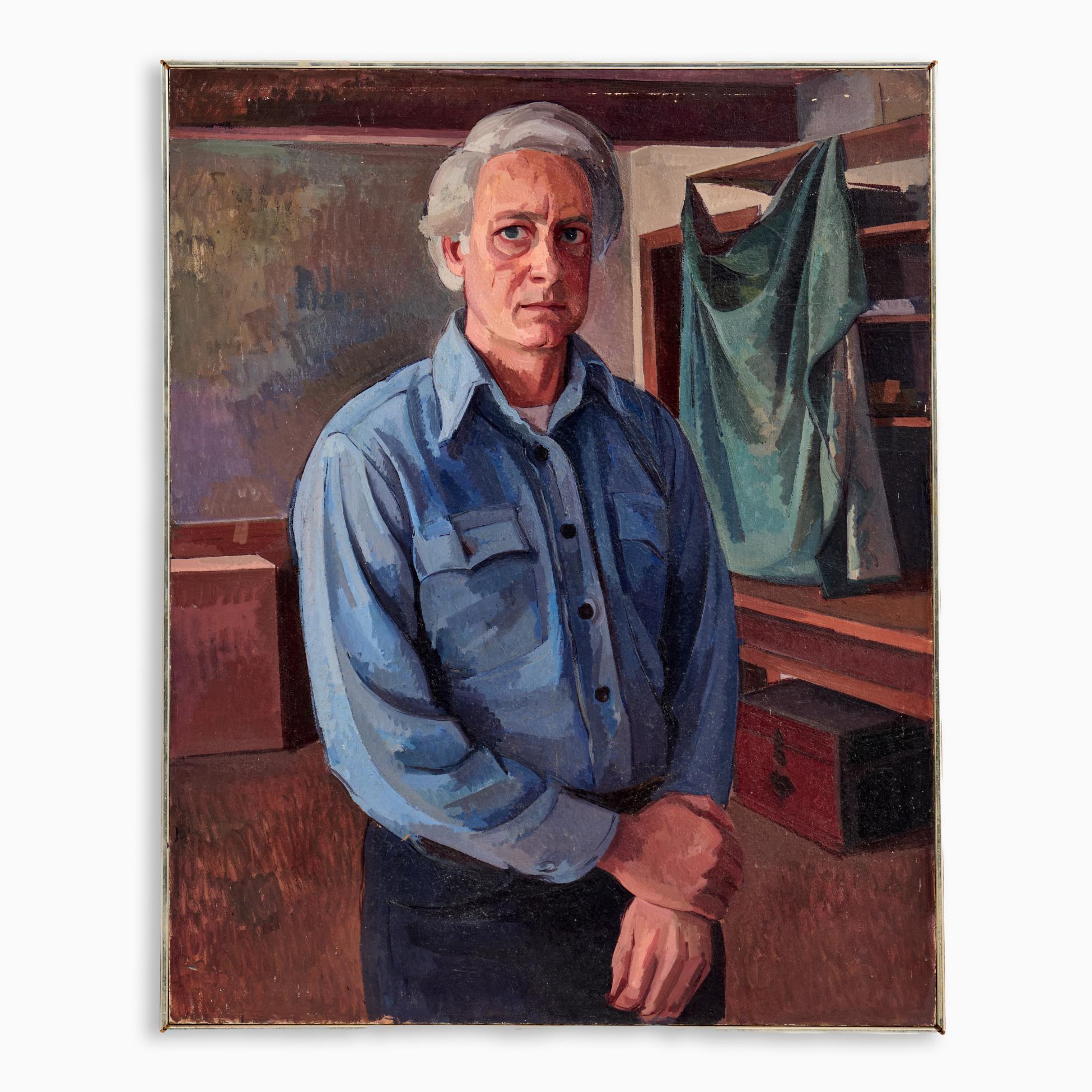
PART THREE: The Contemporary Era
The Art Institute became fully accredited for the first time in 1964. A new crop of long-term professors helped guide the Institute through a rapidly changing contemporary art world. Connections with the local arts community grew stronger, including with the opening of H&R Bloch ArtSpace and with connections to a thriving Crossroads arts district.
Wilbur Niewald (b. 1925)
When Wilbur Niewald first joined the Art Institute faculty in 1949, he painted heavily abstracted landscapes, like a mason building a wall of colorful bricks. But beginning in the early 1970s, he began to paint more directly representationally, with subjects that range from still life to KC cityscapes. To call him intrinsic to the Kansas City art scene is an understatement: his career has spanned decades, seeing the Institute through modern and contemporary movements, and he has affected the careers of countless young painters and printmakers. He continues to create beautiful work today.
Dale Eldred (1934-1993)
Of every artist on this list, Eldred’s work may be the least common to market, because most of his work was made up of temporary, large-scale sculptural installations, often with an interest in light as both concept and medium. Nonetheless, no list would be complete without him, as he was a powerful figure in the history of Kansas City art. His time at the Institute stretched from the 1960s until his tragic death in 1993, and in that time, his thought-provoking presence inspired students and fellow faculty alike. Today, some of his renowned commissions remain, but most of his work is remembered through photography, lithography, and memory. The Nelson-Atkins holds an extensive archive of his work in storage.
Kenneth Ferguson (1928-2004)
Among the most celebrated artists in the school’s past faculty, Ken Ferguson served as chair for KCAI’s Ceramics department from 1964-1996. He was already a master of the craft, but it was during his time at the Institute that he found his own unique artistic language. Inspired by the legendary Peter Voulkos, he shook his work loose from the bounds of functionalism, and became known for taking nominally utilitarian forms and assailing them with dynamic imperfection. Among his most notable works are those that feature his favored hare motif, as well as his signature Slump Jars, a series begun in the early 1980s. Ferguson was instrumental in propelling KCAI to the forefront among ceramics programs around the nation.
Jim Leedy (b. 1930)
The Crossroads District is Kansas City’s central hub for contemporary artists and galleries, and that’s thanks to Jim Leedy. Leedy, a leading Abstract Expressionist ceramicist, began work in KCAI’s sculpture department in 1966, and soon concurrently rented out a studio/gallery to show the work of students and faculty. When he was priced out of his initial Westport space, he found an inexpensive alternative just north of Union Station. Later, he’d buy up more of the affordable area and encourage others to move in to create an arts epicenter, and the area became colloquially known as Leedyville. His Leedy-Voulkos Art Center has now been a pillar of the local arts community since its opening 35 years ago, at once noteworthy and approachable.
Lester Goldman (1942-2005)
Lester Goldman, a native of Philadelphia, was a mainstay of the Kansas City Art Institute’s painting department from the moment Wilbur Niewald convinced him to come to KC in 1966 until a precipitous decline in health in 2004. Goldman as a teacher and an artist was interested in the discovery of art’s limitless possibilities. His early work was figurative, but experimentation with sculpture helped propel him into several decades of experimenting with different kinds of organic abstraction across all media. His most recognizable work involves highly abstracted forms, whether imagined or loosely representational, many of which feel biological in nature.
Warren Rosser (b. 1942)
The Welsh-born Warren Rosser moved to Kansas City to teach at the Institute in 1972, and spent 45 years at the Institute, much of that time as the chair of the painting department. His paintings, created in the language of geometric abstraction and often executed on dimensional surfaces, are meant to evoke a sense of space or architecture, though not in a literal or recognizable sense. He’s influenced decades of students here locally, but made his presence known internationally with exhibitions across the United States and Europe.
It’s imperative to note that this list is in no way comprehensive. There are so many other artists and educators worth talking about from the beginning of the Institute until today– Randall Davey, Glenn Gant, Victor Babu, Victor Papanek, Hugh Merrill, Jane Lackey, and a dozen others. The Art Institute is without question one of Kansas City’s proudest artistic traditions, and will surely continue to be so with the present generation of talented educators.
A partial reading list, for more information on some of the artists mentioned:
Rediscovering George Van Millett (2011) Lynn Mackle, KC Star Books
The Life & Art of Charles A. Wilimovsky: Forgotten Master (2014), Dr. Roland Sabates, Rockhill Books
Ross Braught, 1898-1983: A Visual Diary (2000), David Cleveland, Hirschl & Adler Galleries
An Artist In America (1st edition was 1937), Thomas Hart Benton,
Thomas Hart Benton: An American Original (1989), Dr. Henry Adams, Knopf Inc.
John Stockton de Martelly (1990), Vic Zink, Mid-North Printing Inc.
Frederic James: A Painter from Kansas City (1986), Nelson-Atkins Museum of Art
Wilbur Niewald: A Retrospective (2004), Michael Walling, Albrecht-Kemper
Dale Eldred: Sculpture into Environment (1978), Ralph Coe, Univ. of Kansas
Ken Ferguson: Talking with the Wheel (2007), Ken Ferguson & contributors, Silver Gate
Jim Leedy: Artist Across Boundaries (2000), Matthew Kangas, KCAI